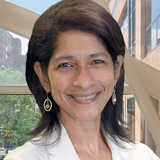
Calderón says her parents instilled in her and her brother the importance of doing what’s right at an early age.
“There was the concept that all people should be treated equally,” she says. It was a concept she would later apply to her passion for medicine.
“My parents came here from Puerto Rico,” says Calderón, who spent her early years in Manhattan’s Chelsea Projects and teen years in Hell’s Kitchen. “They were humble people who worked hard all their lives to provide for me and my brother. Growing up in the projects, I saw a lot of health-related social needs issues.”
Calderón’s father worked in the fabric industry; heavy lifting often caused back spasms so painful that they sent him to the emergency room. While there, she noticed he was treated differently, dismissively, sparking the realization that the underserved community needed help. She pondered how society could ensure that everyone could receive the same treatment regardless of race, religion, and socio-economic status—and decided to do her part through medicine.
The path to a medical career started in her teens when her mother discovered a weekend program for underprivileged high school students interested in science. The founder of the program, philanthropist Alice Miller, would take the students in the program to different medical schools in the area, including Mount Sinai and Columbia, and they would sit in the classrooms while medical students—who were paid a stipend by Miller—would teach simplified lessons in anatomy, histology, embryology, etc.
“I remember thinking, ‘Wow, sitting in this classroom…I can see myself here!’” she says.
It was Miller who insisted Calderón apply to top-tier colleges, including Yale, Brown, and Princeton; Calderón ultimately decided Brown University was the best fit for her. She followed up with medical school at Albert Einstein Medical College in New York.
Because of the opportunities afforded her through a pipeline program, Calderón is dedicated to paying it forward. She developed mentorship programs during her tenure as assistant dean of diversity enhancement at the Albert Einstein College of Medicine, and has already become involved in the Summer Training & Enrichment Program for Upcoming Physicians (STEP UP) Medicine at Jefferson. STEP UP is a comprehensive summer enrichment program designed for underrepresented students who intend to apply to medical school.
Following medical school Calderón completed her medical internship at Beth Israel Medical Center (later Mount Sinai Beth Israel, now closed) and a residency in Emergency Medicine at Jacobi Medical Center, both in the Bronx. She stayed at Jacobi after residency, where she focused on HIV/AIDS among at-risk populations and underserved communities.
In the 2010s, Calderón developed a program called Behavioral Intervention-Rapid HIV Testing Education & Follow-Up (BRIEF) to make HIV testing part of routine medical care in the emergency department.
She initiated the program to test emergency room patients while they were there with results available within 20 minutes. She then combined the rapid testing with a “talking head” video providing information in both English and Spanish encouraging testing, as well as how to practice safe sex.
Calderón was chair of the Department of Emergency Medicine at the Mount Sinai Beth Israel Hospital when the next big health crisis arose—COVID-19.